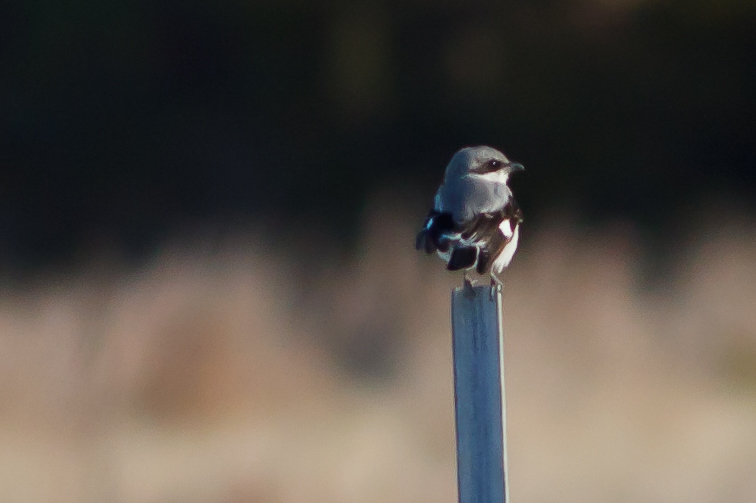
Not #516 Northern Loggerhead Shrike

Sunday, November 7th, 2010

Northern Shrike has been on my target list for a little over a year. It’s not a common bird around New York City, but it does show up regularly in early winter; and when it does it often sticks around one spot for a week or more at a time. However I’ve never before made the effort to chase it, so it doesn’t qualify as a nemesis bird. Nonetheless it was a bit galling when Steve Nanz and the Brooklyn Bird Club found one last week at Jones Beach State Park on a trip I skipped to go to the PDN Photo Expo. Fortunately the bird hung around, probably feeding on Yellow-rumped Warblers and other small birds, and was still near the Theodore Roosevelt Nature Center yesterday where Peter Dorosh, Mary Jo Eyster and myself relocated it yesterday:

Northern Shrike perched on fencepost

(more…)

#515 Common Snipe

Thursday, October 21st, 2010

Thursday I took a long drive (well long for Iceland– the whole country’s about the size of Kentucky) around the Reykjanesbær peninsula. I didn’t see many birds though. The last stop was a small migrant trap called Seltjörn on the road between Njarðvík and Grindavik. This is a park where someone has planted a lot of conifers along a hillside. Iceland doesn’t have a lot of trees, so places like this attract occasional European vagrants. I didn’t find any rarities, but the woods were filled with Redwings, and I’d occasionally encounter a small flock of Common Redpolls.

However the real prize was in the fields west of the trees. Here I flushed two birds that flew rapidly out of the grass and away from me. They looked vaguely like a cross between a shorebird and a Mourning Dove. At first I thought they might be more European Golden Plovers, which I’d been seeing everywhere but that didn’t seem quite right. They didn’t act like them, and this wasn’t the ideal habitat either, but in migration birds can show up anywhere. However 15 minutes later in the way back I flushed a third that burst out of the ground and flew a long looping flight until it landed back in the grass about a hundred meters away from me. This time I was able to get my binoculars on it while it was in flight, and the obvious long straight bill made it very clear this was no plover. (The key defining characteristic of the plover family are their short, stubby bills.) The flight, behavior, bill, and pattern made it really obvious this was a Snipe, and in Iceland more specifically a Common Snipe. This is very closely related to America’s Wilson’s Snipe. Indeed until quite recently they were considered to be the same species, but in 2002 the AOU split them.

#514 Redwing

Tuesday, October 19th, 2010

Today Beth and I drove back to Reykjavik to visit the zoo and Botanical Gardens, and do a bit of shopping. The zoo’s definitely worth a trip. It specializes in Icelandic animals, native and otherwise: Icelandic foxes, horses, mink, goats, cows, pigs, Gyrfalcon, etc. I couldn’t count the captive Gyrfalcon, but I couldn’t avoid Redwing if I tried. There were dozens everywhere:

Redwing in bare tree with red berries

(more…)

#512 and #513 in Downtown Reykjavik

Monday, October 18th, 2010

Monday afternoon I drove Beth and her agent down to Reykjavik to visit a violinist at a lovely sculpture museum on the ocean. (Driving in Iceland is dead easy, by the way. Much simpler than in the U.S. Fewer people means less traffic.) I added Common Loon to the trip list at the museum, but didn’t find any life birds. However, a little later in the afternoon we visited Tjomin Pond in the city center, which is known for harboring many species that don’t winter anywhere else in the country. As usual in city parks in both Europe and America, some the biggest and most obvious waterfowl were Mute Swans. Or at least that’s what I thought at first. These days I hardly even look at swans in parks. However these swans were quite tame, as Mute Swans in parks usually are, and when one swam right up to us, I couldn’t help noticing the bright yellow bill:

Profile of a swan with a yellow and black bill

Wait a minute? Yellow bill? Mute Swans don’t have yellow bills. That’s a Whooper Swan! #512. (I’d seen a Whooper several years ago on the East Pond of Jamaica Bay, but as probable escapees Whoopers aren’t countable in New York. In Iceland they are.)
(more…)

#510 and #511 in Keflavík

Sunday, October 17th, 2010

I arrived in Iceland early this morning and despite hopes for Ptarmigans in the airport parking lot my first Icelandic species was — wait for it — European Starling on the old U.S. Air Force base. Worse yet, it turns out that even though Iceland is in Europe, the starlings aren’t even native here. I’m told they first showed up about 30 years ago. (I have seen European Starling in London and the Netherlands, where they are native birds so I can still include that one on my life list even under the strictest rules.)

That was pretty much it till the afternoon when I got down to the harbor and turned up 11 more species. The first lifer, #510, was a European Shag next to a Great Cormorant. No pictures yet since it was raining and I didn’t want to drag my camera or my scope out in the rain. I’ll try and grab some tomorrow when the sun comes out. There were a few around.
(more…)

#509 Mourning Warbler

Monday, September 6th, 2010

I wasn’t initially planning to go out to Prospect Park on Labor Day. Given that I live right at the end of the route for the West Indian Day Parade, the crowds of the noise are usually quite excessive. It’s just too much trouble to get up and down Eastern Parkway. However, when I heard from Peter Dorosh that a Mourning Warbler had been seen at the south end of the Vale of Kashmir, right near where I usually enter the park, it was just too tempting.

I headed out just after 11:00 AM. Fortunately the start of the parade was just beginning to reach the end of the Eastern Parkway, and the crowds are not too excessive yet submitted to the park fairly quickly and got to the Vale about 11:15. I promptly ran into Tom Stephenson who was also out looking for the bird and hoping to photograph it. We wandered around a bit, later being joined by Phil Malek, and kept looking for the Mourning Warbler. We had some tantalizing possibilities but nothing that looked definite, especially given that there were at least two and probably more Common Yellowthroats wandering around in the vicinity.

The Mourning Warbler is not an especially uncommon bird around here, but it is one that is relatively hard to find because it is a real skulker. It likes to get down in the leaf litter and below the leaves and not come out very much where it can be seen. Tom played the calls and the song of the Mourning Warbler but we didn’t get any responses. That’s not too surprising in the fall when birds are generally not singing and not paying much attention to their song.

Round about noon, Tom decided give up the search and headed home before the parade traffic got too disastrous; and as often happens about 10 minutes later as I was walking along the fence down toward Nellies Lawn, up popped the bird. It was a small brown bird with a completely yellow underside. It was considerably thinner and pointier than a female Common Yellowthroat, the most similar local species. However a Yellowthroat is a much fatter bird. It usually looks like it swallowed a ping-pong ball. This bird was much skinnier and showed complete yellow underneath, not just yellow on the throat and the undertail coverts. The bird also had either a thin eye ring or eye arcs — I didn’t have quite long enough look to tell whether the eye ring was connected or not. On the Mourning Warbler you’d expect that it wouldn’t be connected; on a Yellowthroat you’d expect that it would be. I couldn’t definitively say one way or the other. However, given the expensive yellow on the underside of the bird all the way down to the undertail coverts, and especially given the shape of the bird which was very slender not at all yellowthroat like, I’m very confident in saying that this was a Mourning Warbler.
(more…)