Seawatch Friday Morning

Friday, July 17th, 2009

Finally got my scope repaired after the Birdathon damage back in April (though it was worth it) so I woke up early and spent an hour at Robert Badham watching the sea before work. The good news is that the scope now works again. I’ve missed it sorely over the last couple of months, especially on the monthly Sea & Sage walks at San Joaquin, where we’ve had to make do with a single scope shared among 20+ people. The bad news is that this was not the best morning for a sea watch. The winds weren’t good, and no pelagic species were evident. However I did pull in 15 near-shore species including a Juvenile Wandering Tattler:
(more…)

Costa’s or Anna’s?

Monday, May 4th, 2009

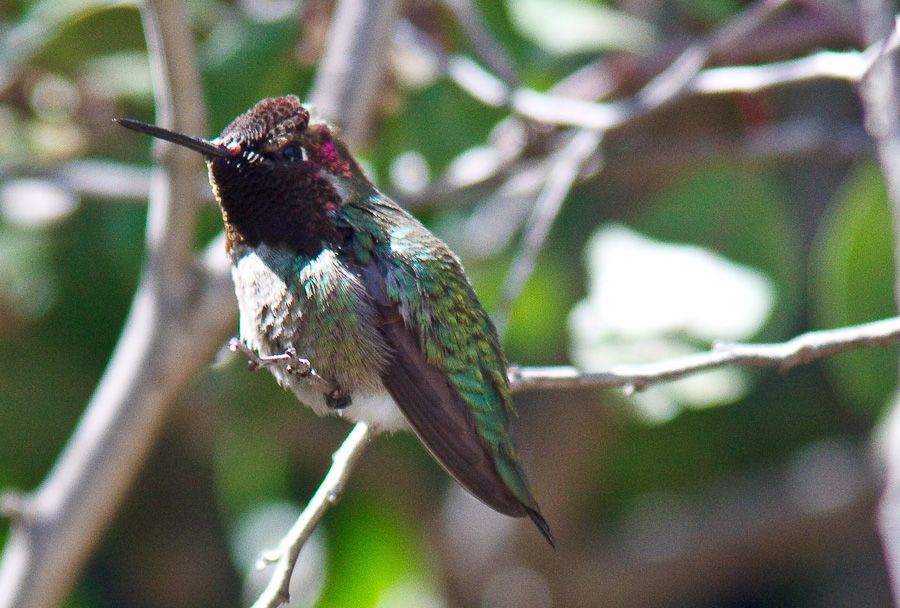
Yesterday at the Tucker Wildlife Sanctuary in Modjeska Canyon, I spent a lot of time looking at this hummingbird:

Male Calypte Hummingbird

The classic distinction between a male Anna’s and a male Costa’s is that the Anna’s has a red gorget while the Costa’s has a purple gorget. The problem is that the much more common (around here at least) Anna’s male can also seem purple depending on angle and light. More than once I’ve sat and watched a hummingbird’s gorget switch from purple to red to purple to red to black to purple to red as it moved its head around. At this point I am extremely cautious about calling any Orange County hummingbird a Costa’s without an expert standing next to me to confirm the ID.

However this hummingbird shows purple in all my photographs and in the field. It never really looked red to me at all. Its gorget did, surprisingly, sometimes look copper, which is a color I’ve never seen on an Anna’s. I’m almost ready to stick my gorget out and call it a Costa’s except that according to Sibley, another distinguishing mark is that the wingtips of the Costa’s extend all the way to the tail tip, while on the Anna’s they’re a bit short. Damn. These wingtips clearly don’t extend all the way to the tail tip, though perhaps that’s a function of the angle or how the bird holds its wings at any given moment?

On the other hand, the more I look at this bird the more it looks violet and Costa’s like and the less Anna’s like it looks. I’m stumped. Anyone want to call this one?

#467 Black-chinned Hummingbird at Santiago Oaks

Saturday, April 11th, 2009

I’ve been visiting Santiago Oaks Regional Park about once a month for over a year now. There’ve been some good life birds there including Rock Wren and Lazuli Bunting, but two regulars have persistently eluded me: Black-chinned Sparrow and Black-chinned Hummingbird. Well, last Sunday April 5 on Linette Lina’s monthly walk we finally found a Black-chinned Hummingbird:

black-chinned-hummingbird

This is a tough one because it’s relatively quiet, and looks a lot like the more common Anna’s Hummingbird unless you see it in really good light. Plus it’s much more skittish of people than an Anna’s or an Allen’s. However it does tend to hover a little more than an Anna’s does, and this one was relatively cooperative.
(more…)

#465 and #466 at the Salton Sea

Friday, April 10th, 2009

A couple of weekends ago (March 21-22), Beth was out of town so I decided to drive farther than normal from my usual O.C. stomping grounds. In particular, I decided to take a spin around the Salton Sea. It’s about 300 miles there, around, and back again, and seemed like a good fit for a weekend. I didn’t get as many life birds as I hoped but I did add two, plus one new species for my California list.

The first bird came almost as soon as I arrived Saturday morning. I drove down Lincoln Street to the Whitewater River delta. However all the gates were closed, and marked off with no trespassing signs. Bummer. However on the way back, I watched an Abert’s Towhee scurry off to the side of the road. This wasn’t a great look, and I might not even count it, except that I saw another one at my last stop of the day at the Sonny Bono Salton Sea Visitor Center, and two more the next morning in a vacant lot in Brawley. More often than not, the first bird is a “Is that what I think it was?” and you have to find a few more to be sure. That was the case for #465.

#466 though, left no room for doubt. I’ve looked for Common Ground-doves, without success at San Joaquin Wildlife Sanctuary in Irvine where they breed; but I found them all over the ground at the Sonny Bono Salton Sea Visitor Center where they were attracted to the feeders. Basically this is a sparrow-sized Mourning Dove. I even got pictures:
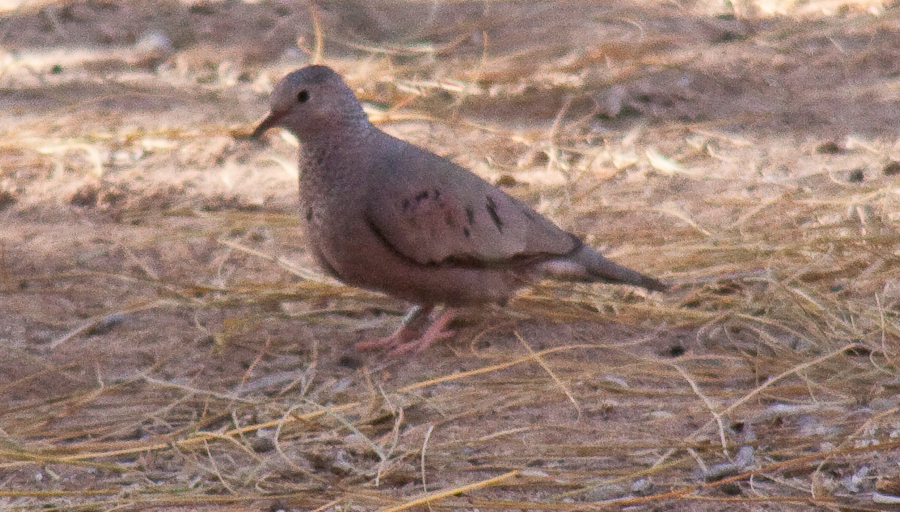
common-ground-dove

Although, just now as I look at the photos I notice this bird was banded. Hmm… That doesn’t necessarily mean it’s not countable; and I did see more than one individual, at least one of which flew. Still if this is not really a wild bird, it doesn’t really count. Fortunately, I found another one the next morning at the Riverview Cemetery in Brawley, and that one counts even if this one doesn’t.

Another birder also showed me a Barn Owl roosting right next to the center. Not a lifer but rare and special nonetheless. I also had a maybe on a Yellow-footed Gull after walking the path out to the Sea, but I couldn’t be quite sure.
(more…)
Starting my New York List for the Year

Tuesday, March 31st, 2009

I visited Brooklyn this past weekend. Despite jet lag, rain, and wind, I managed to spend a few hours in Prospect Park and picked up 39 species including 15 year birds:

  • American Coot
  • American Goldfinch
  • White-throated Sparrow
  • White-breasted Nuthatch
  • Song Sparrow
  • Ruddy Duck
  • Rock Pigeon
  • Ring-billed Gull
  • Red-winged Blackbird
  • Red-tailed Hawk
  • Red-bellied Woodpecker
  • Red-breasted Nuthatch
  • American Robin
  • Black-capped Chickadee
  • Blue Jay
  • Brown-headed Cowbird
  • Canada Goose
  • Common Grackle
  • Double-crested Cormorant
  • Downy Woodpecker
  • Eastern Phoebe
  • European Starling
  • Herring Gull
  • House Finch
  • House Sparrow
  • Mallard
  • Mourning Dove
  • Northern Shoveler
  • Tufted Titmouse
  • Ring-necked Duck
  • Northern Flicker
  • Hermit Thrush
  • Northern Cardinal
  • Wood Duck
  • Great Egret
  • Fox Sparrow
  • Swamp Sparrow
  • Eastern Towhee
  • Brown Creeper

However, I did not find the Red-necked Grebe or the White-winged Crossbills that were reported earlier in the year.

Day 1 at The Salton Sea

Sunday, March 22nd, 2009

Details and pictures to follow but here’s the day list:

  • Mallard
  • Northern Shoveler
  • Horned Grebe
  • Eared Grebe
  • Western Grebe
  • American White Pelican
  • Double-crested Cormorant
  • Great Blue Heron
  • Great Egret
  • Snowy Egret
  • White-faced Ibis
  • Common Moorhen
  • American Coot
  • Black-bellied Plover
  • Killdeer
  • Black-necked Stilt
  • American Avocet
  • Willet
  • Least Sandpiper
  • Bonaparte’s Gull
  • Ring-billed Gull
  • California Gull
  • Herring Gull
  • Glaucous-winged Gull
  • Caspian Tern
  • Forster’s Tern
  • White-winged Dove
  • Mourning Dove
  • Black Phoebe
  • Say’s Phoebe
  • Loggerhead Shrike
  • Violet-green Swallow
  • Verdin
  • Northern Mockingbird
  • European Starling
  • Phainopepla
  • Common Yellowthroat
  • Abert’s Towhee
  • White-crowned Sparrow
  • Brewer’s Blackbird
  • Great-tailed Grackle
  • Brown-headed Cowbird
  • House Finch
  • House Sparrow
  • American Wigeon
  • Cinnamon Teal
  • Green-winged Teal
  • Ruddy Duck
  • Gambel’s Quail
  • Brown Pelican
  • Cattle Egret
  • Northern Harrier
  • American Kestrel
  • Peregrine Falcon
  • Long-billed Curlew
  • Marbled Godwit
  • Long-billed Dowitcher
  • Rock Pigeon
  • Common Ground-Dove
  • Barn Owl
  • Northern Flicker
  • Western Kingbird
  • Blue-gray Gnatcatcher
  • Yellow-rumped Warbler
  • Chipping Sparrow
  • Red-winged Blackbird

(more…)