On Fair Allocation of Scarce Resources

Tuesday, January 6th, 2026

There’s a common problem that arises when there are many more customers than available products. Examples include:

  • Event Tickets: Taylor Swift, Comic-con, the Superbowl, etc.
  • Government programs: low interest mortgages, below market rate housing, visas, etc.
  • Medical care: vaccine appointments
  • Limited goods: Furby, Tickle-me Elmo, the latest game console

In practice these goods are all very inefficiently allocated with badly designed systems that frustrate customers and waste people’s time with no benefit to anyone. People constantly refresh websites waiting to get into a queue. Football fans waited overnight in the cold when the Denver Broncos made Superbowl XII in 1977. And vaccines go first (or maybe second) to young, relatively well-to-do, tech-savvy people who have the skills and time to join Facebook groups and use special software to track down vaccine appointments.

For event tickets, there is an obvious solution in standard economics: raise the price to what the market will bear. Artists don’t always like this since they often prefer to have diehard fans in the crowd instead of one-percenter senior citizens who talk over the music instead of dancing, but it does work.

However, for more important goods like visas and medical care, it’s not OK to allocate first to the people most able to pay. (A few Chicago school economists and libertarians will claim that’s exactly what should happen, but they’re bad people and should feel bad.)

Sometimes it is reasonably possible to choose who’s most deserving or needy of the limited good and assign it to them. Artists sometimes allocate tickets to their fan club first. During Covid, vaccines went first to medical professionals, then to nursing home residents who were at much higher risk of catching the virus and dying from it, and then to people in different age and risk brackets.

However, that last step didn’t work. Once the vaccines started being administered to the general public, the system broke down. Shots went first to people who could navigate complicated online systems and had a PCP who could quickly write a letter attesting to a pre-existing condition that made them eligible. Or who were young enough, healthy enough, and uninfected enough to wait in line for hours to take the place of people with appointments who didn’t show up. Techies wrote Python scripts that pinged their phones when new appointments became available. Younger, healthier, and richer people dominated the vaccine clinics in the early weeks.

The same pattern repeated a couple of years later with monkeypox. Rich, mostly white, gay men got the vast majority of the early shots, while poorer gay men of color waited weeks for appointments. And that rollout worked as well as it did only because it was almost exclusively gay men who were seeking the vaccine. If the vaccine had been more popular with the general population, the allocation would have been far worse.

Another common solution is first come, first serve. Gen Xers still remember lining up outside Mushroom Records (or the local equivalent) for concert tickets. While most event tickets have migrated online these days, it’s still not uncommon to encounter a line of people camped out in front of a Gamestop or sneaker store to score the latest drop. Shakespeare in the Park still doles out tickets like this. Needless to say, this strategy highly prioritizes young, healthy people who can camp out for many hours or even overnight.

Is there a fair solution that gives everyone equal access regardless of wealth, health, or youth? And doesn’t waste many people’s time on economically unproductive activities like sleeping on the sidewalk or constantly clicking the refresh button in Firefox like a mouse waiting for a food pellet to drop? Yes, and surprisingly it’s one that is sometimes used by government programs and almost no one else, though in many cases bureaucracies do it wrong.

That solution is a lottery.
(more…)
How to Use Multiple Credit Cards for a Single Amazon Purchase

Saturday, March 13th, 2010

Amazon doesn’t let you apply multiple credit cards to one purchase. This can be a problem when buying a high ticket item whose cost exceeds your available limit on one card. Probably not a good idea in general, but this happened to me recently when I wanted to use an American Express gift card. However Amazon does let you buy Amazon gift certificates with as many cards as you like in any denomination you like from $5 to $5000.
(more…)

eBay is Unfair to Buyers

Saturday, February 6th, 2010

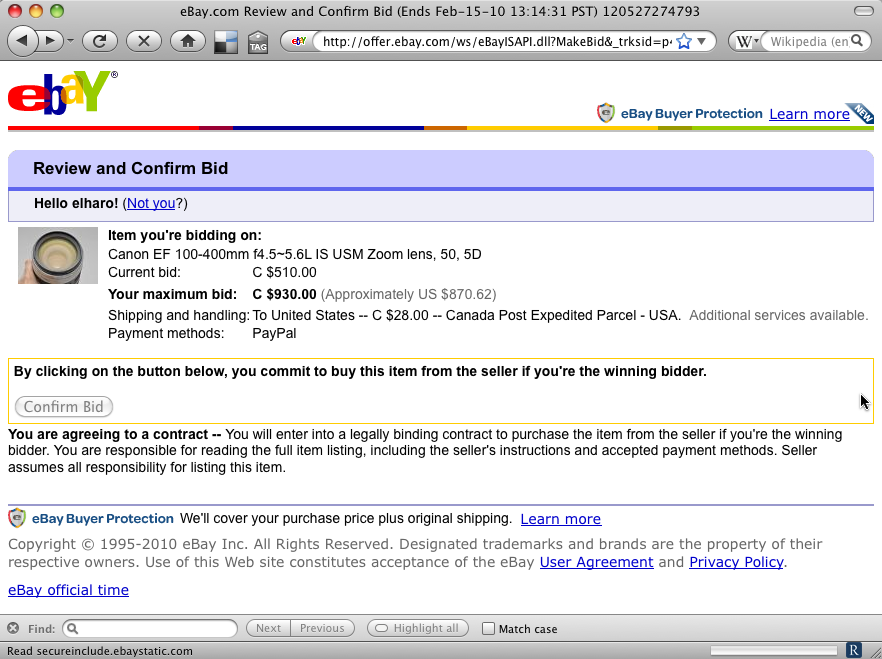
Every time I bid on eBay I see this:

	By clicking on the button below, you commit to buy this item from the seller if you're the winning bidder.
Confirm Bid.
You are agreeing to a contract -- You will enter into a legally binding contract to purchase the item from the seller if you're the winning bidder. You are responsible for reading the full item listing, including the seller's instructions and accepted payment methods. Seller assumes all responsibility for listing this item.

Notice that bit about “You are agreeing to a contract — You will enter into a legally binding contract to purchase the item from the seller if you’re the winning bidder.” Why don’t sellers have to adhere to it too?
(more…)

Newspaper Suicide

Monday, August 3rd, 2009

I am not yet convinced that newspapers are doomed. I am however convince that the inbred bluebloods running major American newspapers will kill their companies. Latest example: I’m reading an interesting article at the Washington Post about the future of newspapers no less. I decide to link to it from one of my sites with the title and the URL and the source, and suggest people go read it. So I try to go back to the first page of the article and I’m hit with a fucking registration page! Why the hell should I have to waste my time typing in yet another fake name and address, and letting them track what I read? What exactly do they expect to gain by this?

I can tell you what they lost: a few hundred extra page views and a few ad clicks that would have made them some money. Not a lot of money I’m sure, but more than enough to cover the miniscule marginal cost of the extra page views. Get enough page views and maybe they can actually cover their fixed costs and start showing a profit on the newspaper for the first time in lord only knows how long. (The Washington Post company did show a profit this quarter, but only because of non-newspaper businesses like Stanley Kaplan, which is apparently now more than half their revenue. Yes, you thought the Washington Post is a newspaper, but really it’s just a corporate shell for test preparation.)

The New York and L.A. Times are just as bad. Half the time I don’t even follow links to those sites because I can never tell when they’re going to show me the article and when they’re just going to block me with a pointless login page. They complain about bloggers stealing their content, but they actively chase potential readers away from their own sites. When your business model is ads (the only business model that has ever worked for newspapers) you don’t try to keep people from looking at your ads. Nor do you reject people who are attempting to boost your circulation. Bloggers know this. New media knows this. Hell, anyone under the age of 40 knows this! Who doesn’t know this? Arthur Ochs Sulzberger, Jr. and Katharine Weymouth to name two. In a world that wasn’t based on nepotistic dynasties, these dinosaurs would be lucky to have a job running the local Penny Saver.

The Internet is over 30 years old. The Web is almost 20. Isn’t it about time newspapers hired someone to run them who actually understands the world we live in? Unfortunately given the shareholder-hostile preferred stock plans at the major media empires, this seems unlikely. When new media writes the final obituaries for the Times and the Posts of the world, the cause of death won’t be listed as the Internet. It will be nothing less than sheer managerial incompetence.

Why Circuit City’s Bankrupt

Friday, January 23rd, 2009

So I stop by my local Circuit City this evening to see if anything worth buying is on sale. I actually have a couple of items in mind. However, the game I want is selling at full list price, despite the going out of business “sale”. The camera I want is actually 10% off, at which price it is still a couple of hundred dollars more expensive than the same camera on Amazon. I do pick up one cheap game that is actually 14 cents less than the price on Amazon, sales tax included.

For all the talk about how Wal-mart killed Circuit City, I’ve never found especially good prices on electronics at Wal-mart (or Target, or K-Mart, or similar); and I’ve never found competent service at Circuity City either, even before the layoffs. It’s Amazon and eBay other web stores that are killing the big box retailers, especially for high margin items that don’t cost a lot to ship. It’s amazing that anyone still buys anything at brick-and-mortar stores like Circuit City and Best Buy.

Buy Negative Today

Friday, November 28th, 2008

As usual today is Buy Nothing Day, in which we reject the notion that shopping is patriotic and endeavor to prove that we are people, not consumers. Usually on the day after Thanksgiving, I attempt (mostly successfully) to spend absolutely nothing, not even subway fare or fast food. But today what if we tried to go one step better? Suppose we actually became a net negative drain for the consumer society? How about today instead of shopping, we returned?

You know you’ve got at least one item sitting on the shelf that needs to go back to the store: the bathing suit that didn’t fit, the gift from Aunt Marge who still thinks your 12, the camera that just flat out doesn’t work. Take some of your free time to gather up the receipts and bring some of this useless flotsam back to its point of origin. Make the cash registers go backwards today.