July 30th, 2011
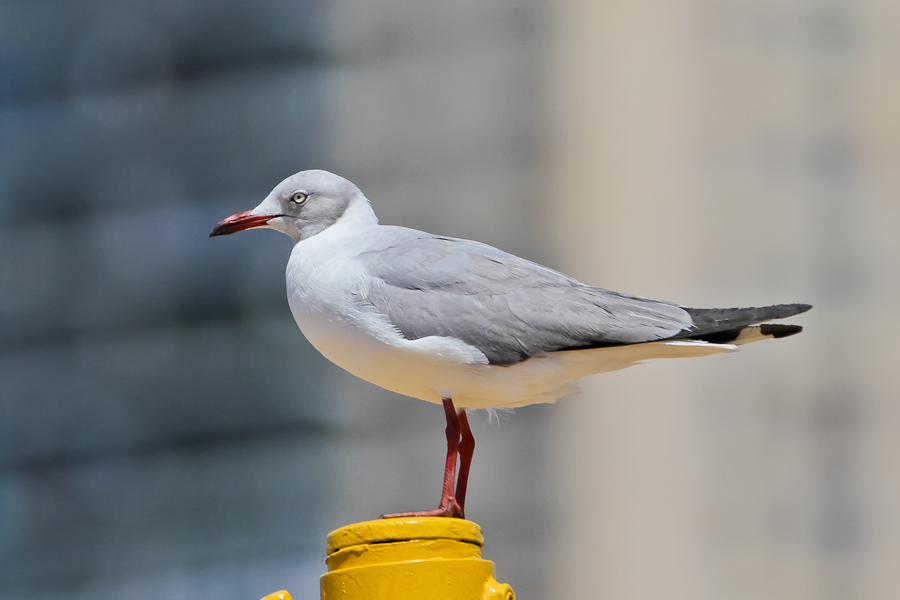
Yesterday morning Doug Gochfeld, the eBird moderator for Kings County, alerted us that an apparent Gray-hooded Gull had been found and photographed on Monday in Coney Island. Apparently it was initially misidentified as a Black-headed Gull–a rare but not mega-rare species around here–so no one paid much attention. It wasn’t until some experts got a look at the photographs to confirm the Black-headed Gull ID that someone realized that this in fact was not a a Black-headed Gull at all at all but instead the Southern Hemisphere species Gray-hooded Gull! A few hardy souls traipsed out to Coney Island yesterday, and around 5:00 PM Shane Blodgett relocated the bird. I heard this around 6:30 PM and decided there wasn’t quite enough light left to make the trek out to Coney Island, which was fortunate because, as I later learned, the bird took off before I could have even left, and only a handful of folks spotted it. The rest were left searching in the rain.
This morning I hear there were upwards of seventy birders scanning the beaches early in the AM. However since the bird had flown off the previous night, and was more likely to be found nearer the second high tide, I decided to hang out in my air conditioned apartment and take the chance that if it was seen again I could get out there fast enough before it took off again.
Around noon, word went out that the bird had just flown in to the same location, so I hopped the S to the Q to Coney Island. I got off at 8th Street/New York Aquarium and walked west down the boardwalk. Somehow I managed to miss the gaggle of birders, and got all the way to 23rd street before I got a phone call telling me to head back east to the Wonder Wheel. And when I arrived, there the bird was, perched on a volleyball pole. Or was it? I swear I couldn’t tell if I was looking at a Laughing Gull or a Gray-hooded Gull. But then the bird took off and flew right past me, and at close range in flight it was a lot more obvious. Bingo! #542. A little later the bird returned and posed for photos:
Read the rest of this entry »
Posted in Birding | No Comments »
July 29th, 2011
Surely I’ve seen a Common Moorhen before now? Well, yes I have. Many times and on more than one continent. However, the American Ornithological Union has just split the species into 2, Common Gallinule (Gallinula cachinnans) in North America and Common Moorhen, (Gallinula chloropus) in Europe. When I heard this I had to check to see if I’d had the bird in Europe and indeed I had, at least four times on my trip to Munich back in March. In fact. I even managed a bad photo of one at Schloss Nymphenburg:
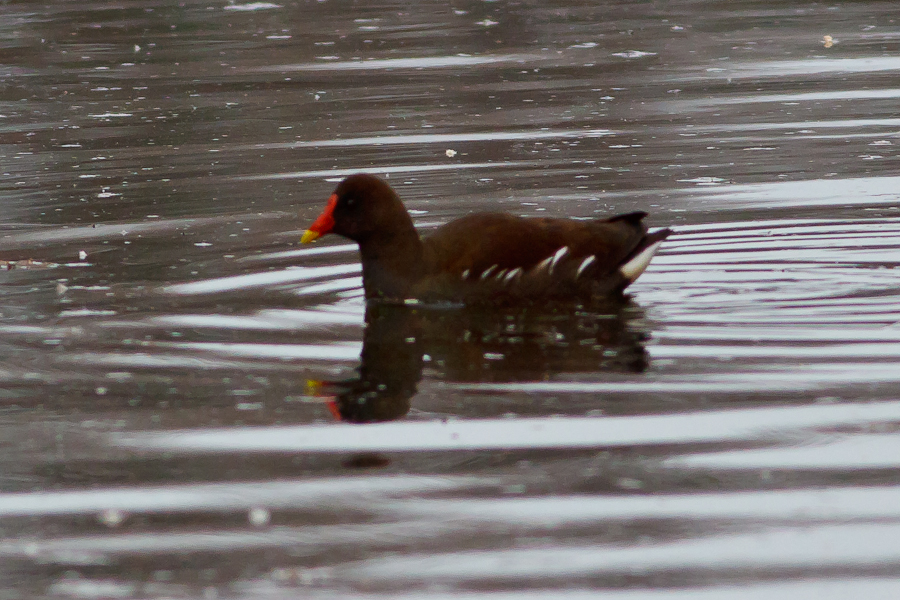
I didn’t think much of it then, but now it counts as a new life bird.
Posted in Birding | No Comments »
July 13th, 2011
I’m trying to come up with a system for rating my photographs in Lightroom. How’s this sound?
5 Stars: Submit to BBC Nature Photographer of the Year, Audubon Magazine Photography Awards, and other contests
4 Stars: Consider making wall prints and framing, using in a calendar, putting in a photo book, submitting to nature magazines, etc.
3 Stars: Submit for Microstock
2 Stars: Upload to Picasa
1 Star: Personal interest; documentation photo. E.g. a personal life bird even with a crappy photo.
0 Stars: Keep
X: Delete
Read the rest of this entry »
Posted in Photography | 2 Comments »
June 22nd, 2011
I just signed up for the Rio Grande Valley Birding Festival in November. I picked the five most intense day trips they had, and I still may not see half the sites I want to visit:
Read the rest of this entry »
Posted in Birding | 1 Comment »
June 9th, 2011
I’d estimate that about 50% of my external hard drives fail over their useful lifetime. The manufacturer doesn’t seem to matter a lot. Lacie, Western Digital, Maxtor, etc. I’ve tried them all and they all fail. Multiple redundant backups, and close attention to signs of problems are necessary to maintain data. And yet to date I think I’ve had exactly 0 hard drives replaced or repaired under warranty. Why? It simply isn’t safe to send hard drives back for replacement. Today’s multi-terabyte drives, and really any drive, contain too much personal data to let it out of my sight; at least not without running it through a degausser that costs as much as several dozen replacement drives first.
Once an external hard drive has failed, it is usually not possible to erase it, much less securely. However the most common mode of failure for an external hard drive seems to be that the enclosure fails, but the data on the platters is still there and can be recovered with enough effort and tools simply by pulling the platters out, and shoving them into a working enclosure. It’s not something I would usually do unless I didn’t have backups. However more often than not it’s something that could be done, either by someone who intercepts the package, a tech working at the hard drive company I return the drive to, or the next warranty servicee who gets back a reconditioned drive with my data still on it. Usually they’d have to use a disk recovery tool to see that data, but sometimes not even that. One third party Mac repair shop once sold me a “new” hard drive that came complete with the contents of someone else’s system: Quicken files, college essays, personal letters, etc.
I recently had the uncommon experience of getting enough warning to erase a hard drive before it failed completely. One of the Western Digital Elements 2.0 TB USB drives I use for rotating Time Machine Backups began making a whining noise. That’s a pretty reliable sign of imminent failure. For a little while, it wouldn’t mount at all, but after some coaxing I got Disk Utility to recognize it and did a single pass erase with all zeros. After that, I was reasonably comfortable sending it back for replacement under warranty. I paid for postage, but otherwise, Western Digital made the process relatively painless. I just entered my serial number in an online form, entered a reason for return, and they gave me a shipping label. I packed the drive up, took it to the mail room, and sent it off. And then a week later they sent me back the wrong drive.
Read the rest of this entry »
Posted in Tech | No Comments »
May 30th, 2011
Looking around my apartment, I notice a significant number of Canon lenses and cameras I’m not using any more. If you’re interested in any of this (especially if you’re in Brooklyn or Manhattan) drop me an e-mail:
- Canon 400 mm f/5.6L lens: $1100
- Tamron AF 70-300mm f/4.0-5.6 SP Di VC USD XLD for Canon Digital SLR Cameras, barely used, $350
- Tamron AF 28-300mm f/3.5-6.3 XR Di LD Aspherical (IF) Macro Ultra Zoom Lens for Canon Digital SLR Cameras: $275
- Canon 18-55 IS II, broken autofocus: $50 or best offer
- Canon Extender 2X II: $250
- Canon Powershot SX30IS, barely used: $350
- Canon Powershot A650IS: $175
Most have original boxes, manuals, chargers, batteries, lenscaps, etc.
The Tamron 70-300mm and the Powershot SX30IS are still under warranty. The rest aren’t. Shipping is not included.
I will also consider trades for Canon DSLRs and pro-grade lenses.
Posted in Photography | No Comments »