October 25th, 2007

European paper-wasp, Polistes dominulus
2007-08-18
Zebra Mussels, Kudzu, Cane Toads, and European Starlings may get more press; but invasive, exotic species are crowding out native insects too. According to Wikipedia, the European Paper Wasp was first noticed in New Jersey in 1968; but the real damage seems to have been done by an infestation starting in Massachusetts in the late 1970s. It has since spread up and down the East Coast. Exactly how much damage it’s doing to native wasp species is an open question. However, on a recent trip to Jamaica Bay Wildlife refuge it was the only wasp I found, and I saw several colonies set up inside bird feeders. This can’t be good.
Pay special attention to the yellow antennae. This is the easiest way to distinguish it from native species such as the Eastern Yellowjacket.
Read the rest of this entry »
Posted in Birding | 1 Comment »
October 24th, 2007

Pipe Organ Mud Dauber, Trypoxylon politum
Brooklyn Botanic Garden, 2007-
Mud Daubers are more recognized by their nests than the wasps themselves. Above we have the nest of the aptly named “Pipe Organ” Mud Dauber. The adults are plain black and relatively non-descript for a wasp. As usually goes along with such non-descriptness, the Pipe Organ Mud Dauber is relatively harmless compared to other wasps such as yellowjackets. They avoid humans, and won’t sting unless seriously provoked (e.g. by catching one in your hand). They will build nests on human habitations. (I found this one outside the men’s room at the Brooklyn Botanic Gardens.) However aside from the aesthetic issues of having mud pipes on your walls, there’s little reason to remove them.
Read the rest of this entry »
Posted in Birding, Bugs | No Comments »
October 23rd, 2007

Eumenes Fraternus
Fort Tilden, Queens, 2007-09-23
Today’s wasp is a member of the Potter Wasp family, which are named after the pot-like mud nests they construct. There are actually several species of Potter Wasps that don’t have individual English common names, probably because they don’t really bother most people and don’t stand out like yellowjackets. Still, these are decent sized wasps (1.5 to 2 cm from head to tail) that are often seen visiting flowers in gardens. As both a pollinator and a caterpillar eater, this wasp is highly beneficial to gardeners.
Read the rest of this entry »
Posted in Birding, Bugs | No Comments »
October 22nd, 2007
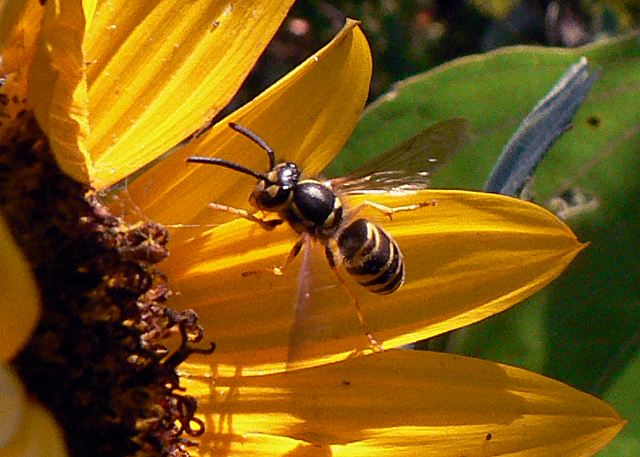
Eastern Yellowjacket, Vespula maculifrons
Floyd Bennett Field, 2007-09-23
This is a female worker. Color patterns vary on drones and queens.
There are actually several yellowjacket species, and quite a few more wasps that look like yellowjackets. There are even flies that mimic this color pattern to scare away potential predators. Maculifrons used to be the most common “true” yellowjacket on the East Coast and still seems to be around New York City. However, in some areas it is losing ground to the invasive German Yellowjacket, Vespula germanica.
Read the rest of this entry »
Posted in Birding, Bugs | No Comments »
October 21st, 2007
I am declaring this to be Wasp Week here on Mokka mit Schlag. I’ll be presenting a new photograph each day of some of my favorite local New York wasps, like this Blue-black Spider Wasp from Hook Mountain. Wasps and bees are much maligned and feared, and consequently I don’t think we pay nearly enough attention to them. However, they’re usually quite harmless as long as you don’t get too close to one or step in a hive. I’ve taken some risks sticking my camera way too close to some of these individuals, so I wouldn’t be surprised if one stung me, but so far the worst that’s happened is that the wasp has flown off to the next flower. (Still, I am thinking it may be time to purchase a camera with a longer lens if I’m going to keep doing this. :-) )

Read the rest of this entry »
Posted in Birding, Bugs | 3 Comments »
October 21st, 2007

American Bird Grasshopper, Schistocerca americana
Ridgewood Reservoir, Queens, NY, 2007-10-20
Steve Nanz found and later ID’d this monster yesterday at Ridgewood Reservoir. It’s one of the largest grasshoppers in North America. When spooked, it flies into a nearby tree, hence the name. It’s uncommon to rare this far north. Neither Steve nor I had ever seen one before. It seems to be more of a southern species. Possibly like yesterday’s Red-banded Hairstreak, global warming may be pushing its range north.
Read the rest of this entry »
Posted in Birding, Bugs | No Comments »